


Ordination to the Diaconate of Rev Niall O’Hara, Rev Derek LeMahieu and Rev James Uhomoibhi.
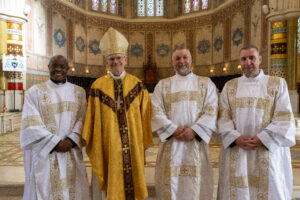
(L-R: Rev James Uhomoibhi, Bishop Alan McGuckian, Rev Derek Le Mahieu and Rev Niall O’Hara)
Homily for Diaconate Ordination
Bishop Alan McGuckian SJ
St Peter’s Cathedral
4th October 2025
I imagine that Derek, Niall and James (and Elaine, Claire and Siobhan) have often had the question posed to them; ‘what is a deacon?’ It is a very good question and if we were to open this up to the floor it would be amazing what all we would hear.
They are ordained and commissioned to Minister the Word of God, to serve at the altar, and to care for the poor and the needy. In a very real sense all of these things are the responsibility of all Christians. We are all responsible for the proclamation of the Word of God; We are all called to participate in offering the sacrifice of the altar; at the Final Judgement we will all hear Jesus say; ‘if you did it to one of the least of these brothers or sisters you did it to me.’ As men who are ordained to this deacons are called to live all of this in an exemplary way.
It is worth highlighting, from today’s second reading (Acts 6:1-6) that when hands were first laid on deacons in ordination, it was very specifically to highlight their duty to care for the poor and needy, in that case to make sure that all of the widows in the community were properly fed.
The dimension I am moved to speak about today is the commission to Minister the Word of God. Two Saturdays ago I met with the three men who are to be ordained deacons today, when they gathered in the chapel of 120 Cliftonville Road in the company of all the deacons of the diocese and the people involved in the formation of deacons. There was a brief ceremony during which the three men made certain statements on oath, placing their hands on the book of the Gospels. They recited the Nicene creed, as a foundational statement of what they believe and who they are. They went on to profess their complete trust in and commitment to the teachings of the Catholic church. It is an exercise that I have always found particularly poignant, bracing, a little bit scary, even unsettling. I have been at the centre of it three times; before I was ordained deacon, priest and, eight years ago, before I was ordained bishop.
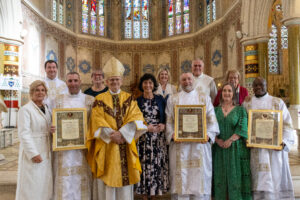
(Newly Ordained Deacons along with their wives and members of the Diocesan Formation Team)
We live in a culture that tells us that science, with its awesome capacity for research, for pushing the boundaries of all that we know about the universe and about all life within it, is the gold standard of human wisdom now; if some people, like us, choose to find meaning in other systems, drink at alternative wells of wisdom and spirituality, they should be free to do so and even encouraged if it gives them some personal consolation. But science is King.
Since the very beginning Christians have confronted this. The Church was born in the Roman Empire and so, in New Testament times they were used to hearing the great Roman claim; Caesar Kurios; Caesar is Lord or Caesar is God. That was their culture, that claimed their submission and allegiance. The answer of the Christians was very simple and uncompromising; Christos Kurios; Christ is Lord, not Caesar; Christ is God, not Caesar; Christ is King. We Christians are called to stand in this truth and you as ministers of the Word have a duty, by your words and actions, to encourage, support and challenge us in all of this.
You must help us to appreciate that when we stand up on a Sunday morning and say ‘I believe in one God, the Father almighty, maker of heaven and earth, of all things visible and invisible,’ that it is a liberating and ennobling truth. We live in a culture, enriched by the ever-accelerating advance of knowledge and control on the part of science and technology; we turn to sociology and psychology for answers to very complex problems; we stand in awe and fear at the rise of artificial intelligence. You must give us confidence that we need have no fear in the face of any of this. Because Christ is King and science and technology and every other created thing is there to serve him.
Another dimension of contemporary culture that we all contend with is the idea that the Ego is the centre of the universe, and the greatest achievement is to live in unfettered freedom – to express myself however I want. ‘I am the master of my fate, I am the captain of my soul’ is a line from a poem that can stir people. We often encourage the young to be the best that they can be; we tell them that if they set their mind on anything they can do it. Those ideas are good as far as they go but they can eat into the soul of a Christian. We know, thank God, that we are not the master of our fate, nor the captain of our ship!
Caesar is not King; the Ego is not king; I am not King. Christ is King. In your preaching and teaching and more importantly by your lives you must show us that the true way to happiness and authentic lives is not unfettered freedom. It is in loving obedience to the Father almighty, maker of heaven and earth. You must encourage us to seek and find in him our deepest fulfilment. Listen again to the words of today’s Gospel (Luke 10:17-24). Jesus is in the presence of a large group of his disciples, not too much smaller than the group of us gathered here: “Filled with joy by the Holy Spirit (Jesus) said: ‘I bless you, Father, Lord of heaven and earth, for hiding these things from the learned and the clever and revealing them to mere children. Yes, Father for that is what it pleased you to do.’”
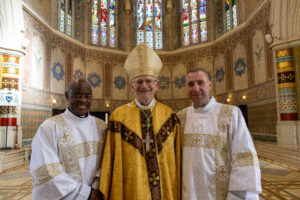
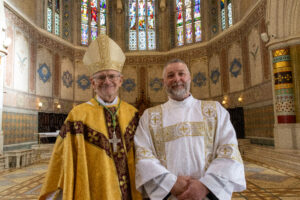
The stance of Christians in the world is not to be standing aside as superior, condescending and finger-wagging though we must live in the truth and proclaim it as Jesus and his Church have given it to us.
Neither are we meant to stand aside from the rest of the world with our particular esoteric wisdom that is cut off from the knowledge of the age and has nothing to say to those who live around us. Remember that St Paul, when he was in Athens, jumped at the chance to speak to everyone in the Areopagus. He spoke humbly and sensitively but he didn’t water down the Christian claims so as to make them sound less ridiculous to his Greek listeners.
In every age Christians have to learn again and again how to stand in our world when we know that Caesar is not king; our culture is not king; Christ is King. All who minister God’s Word have a duty to speak words of wisdom to us, to give us confidence and courage for the task.
Deacons, real authentic deacons can bring something special to this work. In the DNA of deacons is the realisation that their first duty is to care for the poor.
Your proclamation of the Word as deacons will have all the greater power if you show us by your lives that the first and most important mark of the Christians is that when they see their brothers and sisters in need, they roll up their sleeves and serve before they think of anything else.

